
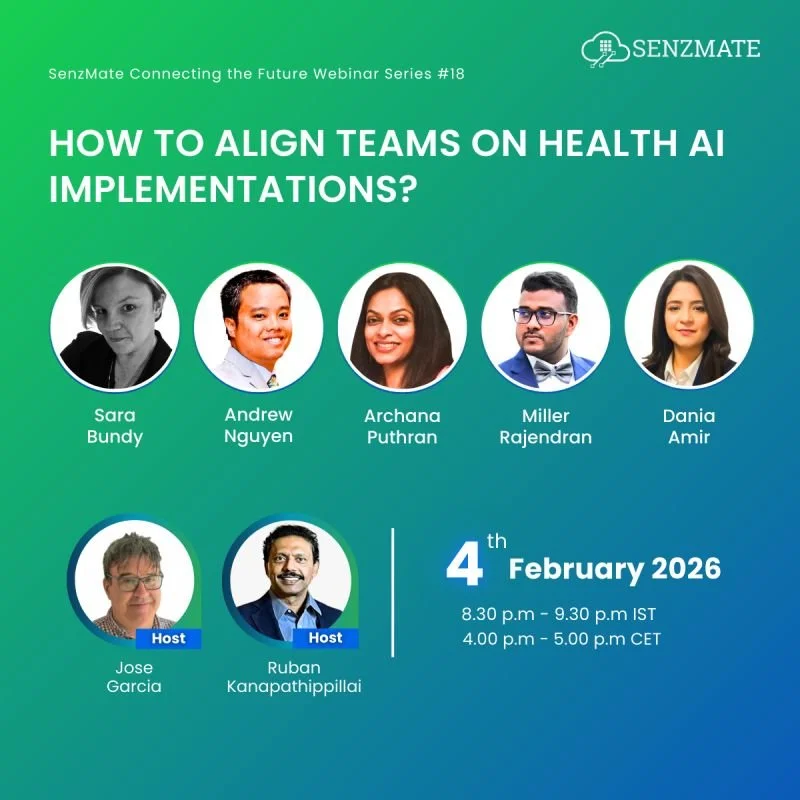
SenzMate Webinar: How to Align Teams on Health AI Implementations
The alignment problem that's keeping patient-first AI from reaching the people who need it most
Seventy percent of healthcare AI projects fail. Not because of bad algorithms. Because teams can't align around what patients actually need.
The Healthcare AI Trap Everyone Falls Into
Here's what happens: healthcare organizations focus on solving individual departmental problems instead of aligning teams around patient outcomes.
Clinicians speak patient outcomes. Data scientists speak model accuracy. IT speaks security. Leadership speaks cost savings.
The result? The most sophisticated AI in the world fails if your clinical, technical, and business teams aren't speaking the same language.
When Silos Win, Patients Lose
When healthcare teams aren't aligned, AI products get built in silos:
Engineers optimize for speed
Clinicians optimize for safety
Nobody optimizes for the patient's complex reality
The output is predictable: tools that add work for clinicians and "AI wins" that optimize efficiency while missing the human reality of care.
This is exactly why so many AI health assistants and patient tools fail to gain adoption—they're built for the system, not for people's daily lives.
What Patient-First AI Actually Means
As an EMT, Neatly Health co-founder Andy learned what "patient-first" really needs to be. Not meeting people in sterile clinical settings, but in their daily lives: in their homes, in the middle of a busy day, between jobs and kids and managing chronic conditions.
Patient-first AI meets people in their lives, not the other way around.
At Neatly Health, we're building AI that helps patients navigate appointments, remember what their doctors said, and advocate for themselves in healthcare settings. But that only works when everyone on the team—from engineering to clinical advisors—understands we're solving for the same thing: healthcare empowerment.
The Conversation Healthcare Organizations Need to Have
How do you align diverse teams around patient-first AI implementation when everyone speaks a different language?
Andy explores this challenge in SenzMate's Connecting Futures webinar series, alongside healthcare leaders navigating the same organizational alignment issues:
Panel participants:
Sarah Bundy – Healthcare transformation leader focused on organizational change
Archana Puthran – Saltgrass Advisory, bringing two decades of technical and functional expertise
Miller Alexander Rajendran – SenzAgro Technologies, Digital Agriculture Strategist
Dr. Dania Amir – Xcelenz, Director of Clinical AI and Internal Medicine Physician (MRCP UK)
Hosted by Jose Garcia and Ruban Kanapathippillai at SenzMate.
Why This Matters for Patients
When healthcare AI teams can't align, it's not just an internal problem—it directly impacts the tools patients end up using.
Misaligned teams create:
AI that adds friction instead of removing it
Tools that feel robotic instead of human-centered
Systems that force patients to adapt instead of meeting them where they are
This is the opposite of healthcare empowerment.
For patients to become active advocates in their care, the AI supporting them needs to be built by teams who understand that patient outcomes come first—not departmental efficiency metrics.
The Healthcare Empowerment Difference
At Neatly, we believe patients shouldn't have to be passive recipients of care. Our AI-powered app helps you:
Record and summarize doctor appointments
Chat with AI that references your specific conversations, not generic health advice
Track symptoms and prepare for appointments with confidence
Advocate for yourself when you feel dismissed or unheard
Because when healthcare teams align around what patients actually need, the tools they build transform the entire care experience.
Want to experience patient-first AI?
Download Neatly and take control of your healthcare journey.
